Beyond Your Backyard: Rethinking Interprovincial and Regional Student Recruitment
With international recruitment less predictable, interprovincial and regional student recruitment deserves a closer look. It starts with understanding why students choose you, not just where they come from.
As application deadlines approach and campus open houses get underway, Canadian colleges and universities have an increasingly important question to consider: Are you recruiting students in the places where they are most likely to choose you?
For many Canadian post-secondary institutions, the next few weeks represent a critical period in the enrolment calendar. Application deadlines are approaching, open houses are underway, prospective students are narrowing their choices, and recruitment teams are working to convert interest into applications and confirmed enrolments.
At the same time, the challenges facing international student recruitment have changed the enrolment equation for many institutions. Policy changes, study permit restrictions, affordability concerns and increased competition have made international recruitment less predictable. For some institutions, this has put renewed pressure on domestic enrolment. For others, domestic recruitment remains strong, and existing targets are already within reach.
Regardless of where an institution sits today, one opportunity deserves a closer look: interprovincial and regional student recruitment.
Is your domestic student recruitment strategy too geographically comfortable?
Most institutions have established recruitment territories. They know their local high schools, feeder communities, regional markets and historical enrolment patterns. They have relationships with guidance counsellors, attend familiar recruitment fairs and return to the same communities year after year. There is good reason for this. Recruitment resources are limited, and investing in markets with a proven history of student interest makes sense.
But historical recruitment patterns can also become a constraint. If your institution is primarily recruiting within its own province, are you overlooking prospective students in neighbouring provinces or other Canadian regions who might be a strong fit? Are there communities with the right student demographics, academic interests and propensity to pursue post-secondary education that simply aren't on your recruitment map?
Interprovincial student recruitment is not necessarily about competing for students everywhere. It is about identifying where there is a credible opportunity to attract students who may not have previously considered your institution.
And that requires a more thoughtful approach than simply expanding your recruitment territory.
Start with why students choose you, not just where they come from
One of the most useful questions an institution can ask is deceptively simple: Why do students choose us?
Application surveys, student decision research, enrolment data and market research can reveal motivations that are much more useful than geography alone. Students may be drawn to a particular program, institutional reputation, campus experience, affordability, career outcomes, sense of community or lifestyle.
These motivations can help identify new recruitment markets that might otherwise be overlooked.
Consider a campaign I developed for an institution where application survey responses revealed something interesting. Students were frequently identifying proximity to the mountains and the beauty of the surrounding city as reasons for choosing the institution.
That insight created an opportunity to look beyond the institution's traditional recruitment markets.
Rather than simply targeting other cities that looked or felt similar, we identified communities that did not necessarily offer the same geographic advantages, but had the right prospective student profiles and potential demand. We then developed a targeted campaign to introduce those audiences to the institution, and more importantly - the city and mountains, and what it could offer them. Internally we called this campaign the ‘ugly cities strategy’, on the outside it looked like this:
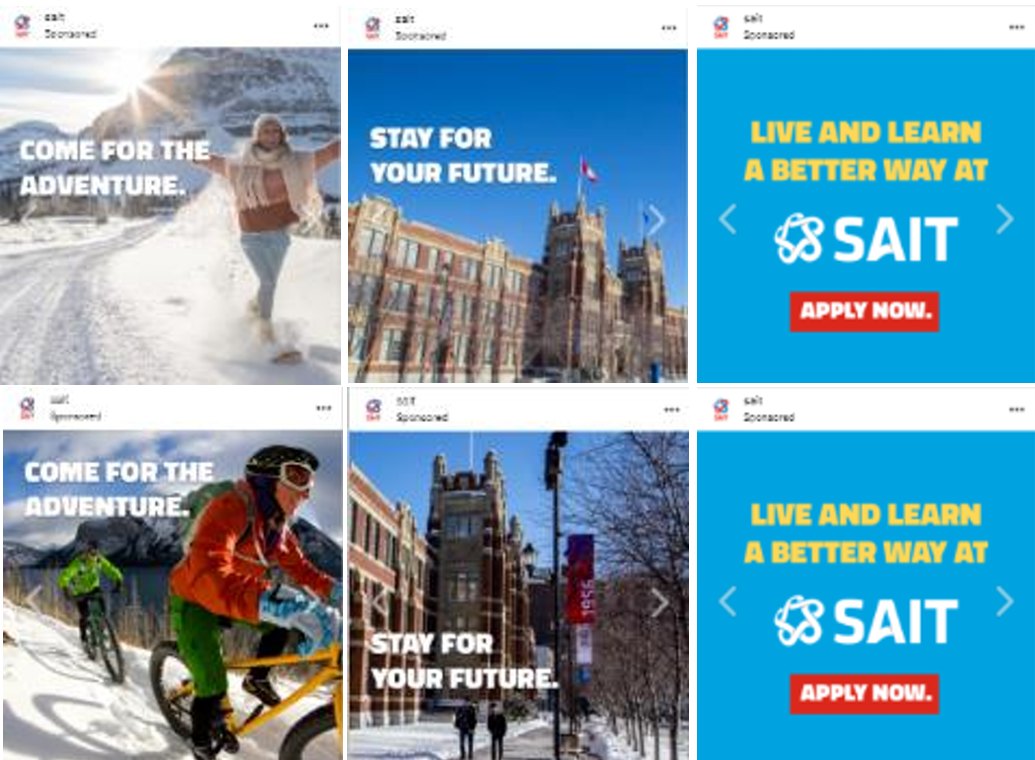
The thinking was straightforward: if students were choosing the institution partly because of the lifestyle and experience associated with its location, could we find prospective students elsewhere who would value those same things, even if they weren't currently considering that destination?
It was a shift from recruiting where students had historically come from already (as we didn’t need to spend money there) to identifying where the next students might come from.
The lesson is important. Your existing student population can tell you a great deal about your potential future recruitment markets, but you need to look beyond the obvious patterns.
Interprovincial recruitment requires more than a bigger advertising budget
Expanding domestic student recruitment into new provinces or regions is not simply a matter of increasing digital advertising spend or adding another recruitment fair to the calendar.
A successful regional student recruitment strategy needs to consider several factors.
1. Identify the right prospective student markets.
Start with demographic and market intelligence. Where are the populations of prospective students? Which communities have the right academic interests, socioeconomic characteristics and propensity to pursue post-secondary education? Are there regions where students are underserved by local program offerings or where your institution has a compelling competitive advantage?
2. Understand what motivates students in those markets.
A student in another province may have very different considerations from someone living 30 minutes from campus. Cost of relocation, housing availability, distance from family, employment opportunities, climate, lifestyle and perceptions of the destination can all influence their decision.
Understanding these motivations is essential to developing relevant recruitment messaging.
3. Make the case for leaving home.
Interprovincial recruitment involves competing not only with other institutions, but also with the appeal of staying close to home. Institutions need to communicate the value of relocating, including the academic experience, career opportunities, campus community and quality of life.
4. Align recruitment messaging with actual student motivations.
Generic messages about academic excellence, student experience and campus facilities are unlikely to create meaningful differentiation. Recruitment campaigns need to give prospective students a compelling reason to choose your institution over the alternatives available in their home province.
5. Connect recruitment to the student experience.
Attracting a student from another province is only part of the equation. Institutions also need to consider the supports, services, housing, orientation and sense of belonging that will help those students successfully transition to a new community.
Recruitment promises need to align with the experience students will actually have once they arrive.
Not every institution needs more domestic enrolment. But every institution needs to understand its markets.
There is an important distinction between institutions that need to replace lost international enrolment, those looking to diversify their student population, and those that have already achieved their domestic recruitment targets.
A college or university that has reached its domestic enrolment goals may have little immediate incentive to expand into new markets. In fact, doing so without considering program capacity, student services and institutional resources could create unnecessary pressure.
But that doesn't mean regional and interprovincial market intelligence has no value.
Understanding where future student demand is emerging, how competitors are positioning themselves and what motivates students to relocate can help institutions make better decisions about program development, recruitment investment and long-term enrolment planning.
For institutions facing enrolment pressure, these insights can help identify new sources of domestic student demand. For those with stronger enrolment positions, they can support market diversification and future planning.
The point isn't that every institution should recruit everywhere. It's that every institution should understand where its next students could come from.
The next recruitment market might not be where you think
Canadian post-secondary institutions are operating in a more competitive and unpredictable enrolment environment. International recruitment pressures have made domestic student attraction more consequential for some, while demographic shifts, regional competition and changing student expectations continue to influence recruitment across the sector.
As application deadlines approach and prospective students make their decisions, institutions should be asking more than how many applications are coming in.
They should be asking whether they are reaching the right students, in the right markets, with the right reasons to choose them.
Sometimes the opportunity isn't in recruiting harder in the markets you already know. It's in looking at the evidence, challenging your assumptions and finding the students you haven't been talking to yet.
We can help. Say hello: hello@tinct.ca
More from the bench
Race Cars, Robots and the Problem with Looking Innovative
Engineering programs are competing in an increasingly crowded category, where innovation, hands-on learning, race cars, robots and research have become familiar signals rather than distinctive ones. Drawing on research across six Canadian engineering programs, we explored where the real opportunities for distinctiveness may lie—and what universities could be saying, showing and owning that others aren’t.

Dr. Lindsey Fair
October 6, 2026
Most campuses don't have a marketing challenge
After a thousand stakeholder interviews, the pattern is hard to miss: the institutions that struggle to recruit are rarely the ones with the weakest message. They're the ones that never checked whether anybody was listening.

JP Rains
September 18, 2026